
How to pay on Cheung Chau: cash, card, Octopus and QR
The island answers "how do I pay?" in two different ways. At Central Pier 5 the turnstile takes an Octopus card, Hong Kong dollar cash and QR codes for a single journey. Along Pak She Praya Road the seafood stalls want notes, and not every stall or vendor on the island takes cards or e-payments.
So carry both: an Octopus for the gate and the counters, and Hong Kong dollar notes for the stalls. The card is the faster half of the trip, and it can be topped up with cash once you are on the island.
Cards and contactless: what the pier takes
Sun Ferry's gate at Central Pier 5 reads an Octopus card. Hong Kong dollar cash is paid at the gate, and a QR reader beside the Octopus pad takes the three codes listed further down this page. An Octopus is the card that gets you through the turnstile; the operator's notes to passengers carry the gate rules and the ticket conditions.
A taxi to the pier now has to offer two kinds of e-payment. Since April 2026 every Hong Kong taxi driver must take at least one QR method — AlipayHK, WeChat Pay HK or BoC Pay — and one non-QR method: an Octopus card, a credit card or FPS. Cash still works, and the government announcement of the rule says what to look for: stickers on the cab window list what that car takes, so read them before you get in.
On the island, the counter decides. Ask before you order in a small shop: a card slot or a contactless pad at the till is that shop's answer to the question, and the shop next door can answer differently. AlipayHK runs inside Apple Pay wherever the Apple Pay or contactless sign is shown.
Octopus: buy it at Central, top it up on the island
An adult On-Loan card is HK$50 deposit plus HK$150 of stored value, and the deposit comes back when the card is returned. Child and elder cards start with HK$50 of value and a Personalised card with HK$130. Buy or rent one at an MTR Customer Service Centre — Central station is the nearest to Pier 5, a walk through the IFC footbridge. Every station sells them except Airport, Hin Keng, Kai Tak, Lei Tung, Lo Wu, Lok Ma Chau, Racecourse, South Horizons, Sung Wong Toi, To Kwa Wan and Wong Chuk Hang.
| What | Figure |
| On-Loan adult card | HK$50 refundable deposit plus HK$150 stored value |
| On-Loan child or elder card | HK$50 stored value |
| Sold Tourist Octopus | HK$39, no stored value, no deposit, card cost not refundable |
| Stored-value ceiling | HK$1,000, or HK$3,000 on a card issued on or after 1 December 2019 |
| Cash top-up at a counter | Up to HK$3,000 at a time |
| Below-zero balance on one tap | Up to HK$50, or HK$35 on a card issued before 1 October 2017 |
| Refund fee on an On-Loan card | HK$11 or 1% of the remaining value, whichever is higher |
The card is taken anywhere you see the Octopus sign. The issuer lists the MTR, buses, ferries, public light buses, coaches and trams, and among the shops bakeries, fast food, Hong Kong-style cafés, coffee shops, cinemas and theme parks — the operator's tourist page puts it at over 180,000 acceptance points.
On the ferry the card does one specific job. Octopus users take the deluxe-class voucher when they pass through the Octopus turnstile gate; the deluxe upgrade is paid at the pier, not on board.
Topping up is a shop transaction. Cash add-value runs at thousands of Authorised Add Value Service Providers — 7-Eleven, Circle K, Wellcome, ParknShop, McDonald's and Starbucks among them — up to HK$3,000. If you are running the card on an iPhone or Apple Watch, the Octopus App for Tourists adds a card to an iPhone X or later or an Apple Watch Series 3 or later, and tops it up with a non-Hong Kong Mastercard, UnionPay or Visa card, the e-CNY App or Weixin Pay.
A low balance is rarely a wall: one tap can take the card up to HK$50 below zero, and the ceiling on what you may hold is HK$1,000, or HK$3,000 on a card issued on or after 1 December 2019. Before you fly home, the refund fee is HK$11 or 1% of the remaining value, whichever is higher, if the card goes back within 90 days, holds over HK$1,000, or has five or fewer payment transactions on it. Under HK$1,000 is paid at any MTR Customer Service Centre on the spot; HK$1,000 or more goes back to Octopus Cards Ltd, with notice within nine working days, as the refund rules set out.
QR wallets: three codes at the gate, and the rails behind them
Sun Ferry's notice of 21 December 2023 lists three QR codes at the pier gates: AlipayHK EasyGo, the Alipay Transport QR Code and the UnionPay Transit QR Code. All three buy a single journey only — not a monthly, student monthly, multi-ride or holiday-return ticket — and the UnionPay code cannot pay a child or senior fare.
Those three codes are not one system, and neither are the wallets behind them. Hong Kong's phone payments run on two separate rails, and a wallet sitting on one tells you nothing about the other.
Wallet acceptance. On this rail the shop's till scans the payment code in your App, and the Alipay or Alipay+ acceptance mark on the stand is what tells you it will work. AlipayHK's own site claims over 150,000 partner merchants in Hong Kong.
The interbank QR link. Hong Kong's FPS and Thailand's PromptPay are joined under a separate scheme launched on 4 December 2023 by the Hong Kong Monetary Authority and the Bank of Thailand, run by HKICL and NITMX and settled through HSBC and Bangkok Bank. The Hong Kong side is seven banks — Bank of China (Hong Kong), Bank of Communications (Hong Kong), Bank of East Asia, Citibank (Hong Kong), Fubon Bank (Hong Kong), Hang Seng and HSBC — plus three stored-value facilities: HKT Payment, Octopus Cards Ltd and Yintran. AlipayHK is not on that list; the scheme's participant list is the one to check.
That list settles the two cases a visitor runs into. A Thai bank app on the PromptPay side pays a Hong Kong FPS QR where the shop displays one, and the Octopus Wallet is on the same list, so the Octopus App is the Hong Kong wallet to reach for at a Thai QR. The operator's own footnote sets the limit: some non-participating Thai banks' codes, and PromptPay personal QR codes, do not work with the FPS × PromptPay link. A static code means you type the amount in THB yourself; a dynamic one arrives pre-filled, and its rate preview expires if you sit on it.
AlipayHK's site claims payment in over 100 countries and regions; its cross-border page names only mainland China, Macao, Japan, South Korea and Singapore — Thailand is not among them, so a Thai PromptPay QR is not something to count on from that wallet. Where the App does quote a cross-border payment it charges no additional fee on the designated methods; your bank or card issuer may still charge for the transaction, the exchange rate or a cash advance. A foreign Visa or Mastercard can be linked, with availability, limits and functions set by the issuer and shown in the App, and registration needs a Hong Kong mobile number and an SMS code.
Cash and ATMs on the island
There are ATMs on Cheung Chau, on the Praya a short walk from the ferry pier, and a bank branch in the village. The fee a foreign card meets at a Hong Kong machine is set by the bank that issued the card, not by the machine, and the same issuer sets the per-transaction limit; the machine shows the charge on screen before it pays out.
Cash works at the pier. Hong Kong dollar notes are accepted at the gate, but coins are capped: HK$1, HK$2 and HK$5 coins cannot make up more than HK$100 of one payment, and 10, 20 and 50-cent coins cannot make up more than HK$2. A pocketful of small change will not buy a fare.
A ticket is for the sailing you are boarding. There is no advance purchase, no exchange and no refund, and on Inter-islands sailings no change is given and no ticket is issued, so have the coins or the card ready before you reach the gate. The routes themselves are in our kaito and inter-island ferry guide. Multi-ride tickets are priced per route: six trips on the Central (Pier 5)–Cheung Chau crossing cost HK$93.40, 12 trips HK$183.70 and 20 trips HK$306.20 — and none of them is a ticket a QR code at the gate can buy.
Where cash decides the day
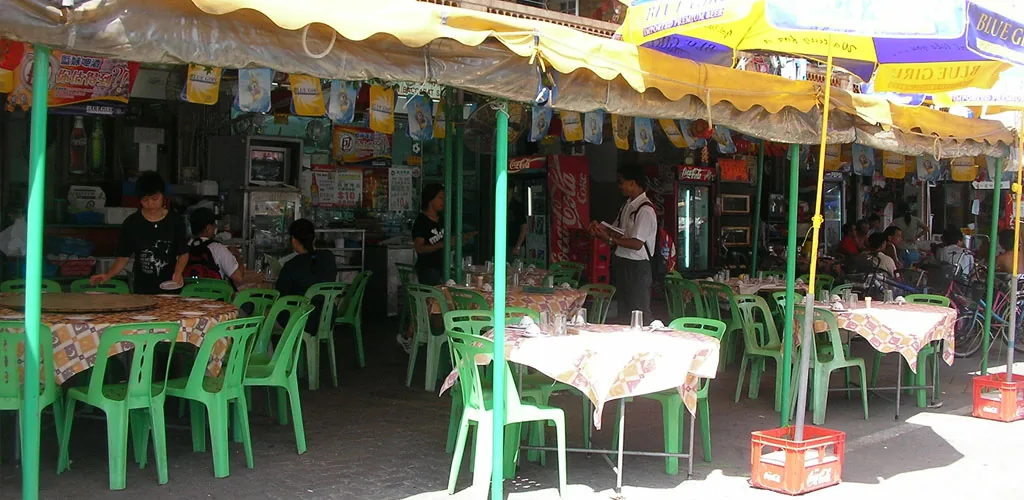
The seafood stalls along Pak She Praya Road are the clearest case: cash is the working medium there, and not every stall takes a card or a phone. Walk the Praya with notes in your pocket; our guide to the island's seafood restaurants and stalls covers the seafood side, and what to buy on Cheung Chau covers the dried seafood, shrimp paste and market shops behind them.
At the pier, cash is the fallback that always works: notes are taken at the gate, subject to the coin limits above. Carry a few tens and fifties rather than one large note, and the same rule serves you at the stalls.
A multi-ride book is not a ticket the QR codes at the gate can buy, and the deluxe-class upgrade on the ordinary ferry is paid at the pier rather than on board — so both are pier-counter business before you pass the turnstile.
Tipping
Most Hong Kong restaurants add a 10% service charge, though some tea cafés do not, and unrequested tea, condiments or snacks are added to the bill — the Hong Kong Tourism Board's traveller guidance sets out both. Read the bill before you add anything on top, and expect the tea and the condiments to be lines on it.
Nothing is added for tax. Hong Kong has no VAT and no GST, so the price on the menu is the price before the service charge and the tea.
Check before you pay
A QR code at a Cheung Chau counter is either the shop's merchant code or somebody's personal account, and the two look different before you commit.
- A merchant QR is printed or mounted on a stand, carries the shop's name and an Alipay, Alipay+ or FPS acceptance mark, and on a dynamic code the amount is already filled in.
- A personal QR is hand-written on a sticker or shown on the vendor's phone, and pays a person by name, phone number or email rather than a shop. It may still go through; it is not the till, and it gives you no receipt.
If your wallet refuses a personal code, stop there. Ask for the shop's merchant QR — if there is not one, pay cash, or walk to an ATM on the Praya. At the pier the test is simpler: look for the QR reader beside the Octopus pad, and pay cash at the gate if the reader will not take your code. The code buys a single journey, so a student, monthly or multi-ride ticket is not bought with it.
For a card, ask before you order in a small shop. A card slot or a contactless pad at the till is the answer; if the till has neither, pay cash. If you are deciding which sailing to take, the next ferry times from Central Pier 5 show the departures, and our guide to getting to Cheung Chau has the fares, the crossing times and the walk from Central station.
All details correct at time of publication.